Using a Fragrance Museum Visit to Build an E-Commerce Scent Line
An e-commerce brand sells scent without ever letting a shopper smell it, so its real bottleneck is language and shortlisting rather than production. A fragrance museum visit earns its place on the calendar because it does two things a sample box cannot: it puts dozens of reference smells in front of the same nose in one sitting, and it forces the team to say out loud what each one is. Go with a written template and a fixed set of questions, not a camera and a vague intention to be inspired.
Key takeaways
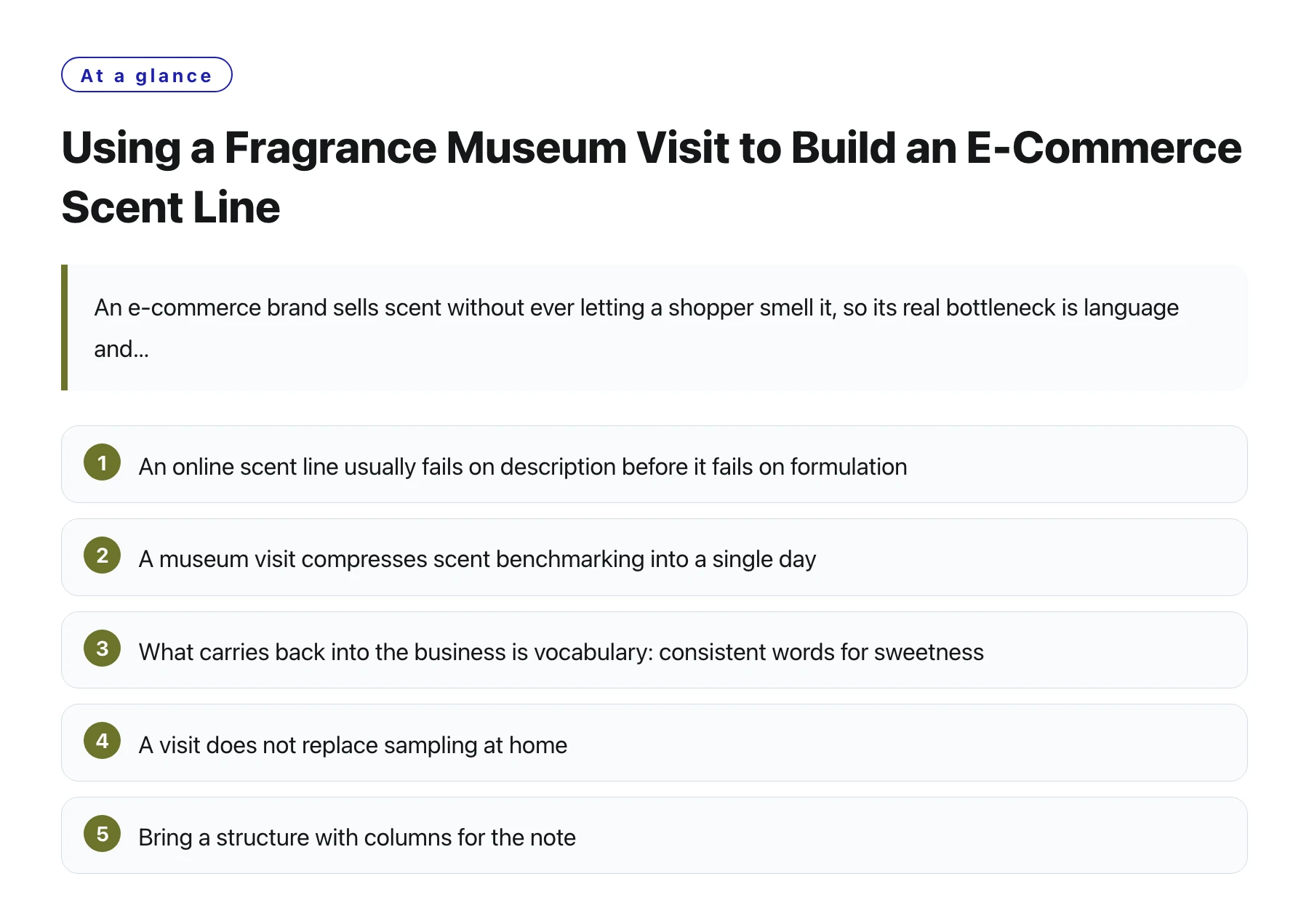
- An online scent line usually fails on description before it fails on formulation, because shoppers decide from words, images and reviews rather than from smell.
- A museum visit compresses scent benchmarking into a single day, which makes candidate directions easier to compare against one fixed memory.
- What carries back into the business is vocabulary: consistent words for sweetness, freshness, weight and warmth that can be reused in briefs and product pages.
- A visit does not replace sampling at home; it produces the shortlist that later sampling confirms on skin and on paper over several days.
- Bring a structure with columns for the note, the honest reaction and the product idea, or the day dissolves into a pleasant blur.
Most first-time fragrance founders treat the museum as a marketing outing. It is more useful as a working session. The reason is simple: smell is the hardest sense to hold in memory, and the hardest to describe in writing, which is exactly the medium an online store depends on.
A museum or scent exhibition gives you a dense, ordered set of references in one afternoon. That density matters more than the drama of any single exhibit, because comparison is what turns a vague preference into a direction a perfumer can actually work with.
The trick is to arrive with a job to do. Below is a way to run the visit, what to record, and how the notes turn into a product page rather than a photo album.
Why an online brand needs a physical reference set
In a physical store, a shopper can test three fragrances and buy the one that smells right. Online, the same shopper reads a paragraph, looks at a photograph of a bottle and checks a returns policy. Your description is doing the work that a tester strip would otherwise do, and if the description is generic the conversion problem will be blamed on the traffic.
Museums and scent exhibitions exist to make smell legible to ordinary visitors, which is precisely the skill an online brand needs. Museums as a sector have spent decades working out how to present material so that a general audience can interpret it, and that discipline transfers directly to how you explain a scent to someone who has never encountered it [1].
The cost of a weak scent vocabulary
A team that describes everything as fresh, sweet or nice will approve a sample that does not match the brief, because nobody can state what is missing. The failure shows up months later as a returned order or a product page that reads exactly like a competitor's.
What a museum can and cannot give you
It can give you range: familiar families side by side, unusual materials you would never have ordered, and the experience of how a scent changes in the first minute. It cannot tell you how a fragrance performs on a customer's skin across a working day, and it cannot tell you what your own market will buy. Treat it as the front end of selection, not the decision. Exhibition practice is built around interpretation and context rather than commercial prediction, and that is the honest limit of what it offers [2].
Range is the whole argument for going somewhere purpose-built rather than ordering ten samples. A collection such as the Xuelei Fragrance Museum, which the company describes as the largest of its kind, is useful to an online brand for a blunt reason: the exhibits span families you would never think to order, so the shortlist is built from a wider set than your own assumptions would produce.
What to settle in person and what to settle online
| Decision | Better in person | Better online | Why it splits this way |
|---|---|---|---|
| Scent family shortlist | Yes | No | Families are easier to compare when they are smelled minutes apart |
| Exact formula direction | Partly | Yes | Direction needs iteration, and that happens through samples and emails |
| Words for the product page | Yes | Partly | Live reactions produce honest language that a supplier brief cannot invent |
| Price and margin | No | Yes | Cost depends on quote lines, not on the visit |
| Packaging and bottle feel | Partly | Yes | Weight and finish matter in the hand, but tooling choices need quotes |
Read the middle column honestly. A visit is a filter, and a filter is only valuable if it removes options. If you come back with twenty scent ideas and no rejected ones, the day was entertainment.
A visit plan that produces usable notes
- Fix the brief before you goWrite one sentence describing the customer, the price point and the season, then judge every smell against it.
- Work in blocks of eightSmell no more than about eight references in a row, then rest your nose for ten minutes and record what you remember.
- Record the reaction before the noteWrite your first reaction in plain words, then look up the listed notes; this prevents the label from dictating what you think you smell.
- Keep one reference anchorPick a single smell you know well and re-test it twice during the day to check that your nose is still calibrated.
- Name three rejects with reasonsRejections are the most reusable output. Write down why something was wrong, not only what was right.
The most common mistake is treating the visit as a team-building afternoon and bringing back photographs of display cases. Book a working session instead: a template with four columns, a fixed anchor fragrance, and a hard rule that every candidate gets a rejection reason as well as a compliment. That single rule turns a pleasant day into a shortlist you can hand to a perfume developer. It also helps to see how other teams have turned a similar starting point into a range, which is why the brands behind these scents is worth a look before you narrow the list too far.
From visit notes to a product page
Back at the desk, sort the notes into three groups: smells worth developing, smells worth referencing, and smells worth avoiding. Only the first group goes into a development brief. The second group is more valuable than founders expect, because a reference gives a developer a target and gives your copywriter a vocabulary that customers already understand.
The third group protects the brand. If everyone on the team reacted badly to a heavy sweet accord at the same point in the day, that is evidence about your customer's likely reaction, and it is worth writing into the brief as an exclusion.
Eventually the notes have to meet production reality, and that is where the manufacturing side matters. A partner set up for fragrance manufacturing under one roof can tell you which of your shortlisted directions are straightforward to produce and which depend on expensive materials or difficult packaging, and that conversation is cheaper before the range is fixed than after.
Write the product page while the notes are fresh
Draft the description in the same week. A useful test is whether a reader who has never smelled the product can predict whether they would like it, and whether the description contains at least one specific word that a competitor could not honestly copy. The museum provides that specificity; the office tends to smooth it away.
Plan the second visit for a different reason
One visit establishes range. A later visit is more useful if it is aimed at a single unanswered question, such as how your shortlisted direction behaves in humid weather or how it reads next to a strong home fragrance in the same range. Aimed visits cost the same as unfocused ones and produce far more.
Sources
- ICOM — International Council of Museums —— The international organisation representing museums; publishes the ICOM museum definition and professional standards for museum practice.
- Museums Association —— A professional body for museums, publishing guidance and research on museum practice and visitor experience.
Frequently asked questions
Is a fragrance museum visit useful if I am launching only one perfume?
Yes, and it may be more useful than for a brand building a range. With one product, the brief has to be sharp because there is no portfolio to absorb a weak launch. A visit that ends with three defined directions and two clear rejections gives a single-product brief more to work with than a month of browsing online.
How long should the visit be?
Half a day of active smelling is usually the practical limit before fatigue distorts judgement. Plan blocks of about eight references with rests between them, and stop when the anchor fragrance starts to smell different from how it smelled at the start.
Can I do the same work with a sample set ordered online?
Partly. A sample set at home is better for testing on skin over several days, which a museum cannot replicate. It is worse for range, because you only receive what you already thought to order, and for language, because there is no guide telling you what you are smelling.
What should I bring to a scent museum?
A printed template with columns for the reference, your first reaction, the listed notes and a possible product idea; a pen; water; unscented coffee beans if you find them useful; and one fragrance you know well as an anchor. Leave the camera in the bag unless the venue allows photography and you have a specific reason for it.
How do visit notes feed into a manufacturing brief?
They become the reference and exclusion list. Give the developer the smells you want to be close to, the smells you want to avoid, the price band and the market, and let the development work start from that. A brief built on references and exclusions produces fewer wasted iterations than one built on adjectives alone.