OEM vs ODM Cosmetics Manufacturing: Which Route Fits Your Brand
The two acronyms describe who owns the work, not just who does it. Under OEM the brand brings the formula; under ODM the manufacturer develops it and returns a product close to market-ready. That ownership choice drives the calendar too: ODM runs 4–8 weeks with an existing formula, while OEM takes 3–6 months once development, testing and production are counted.
Key takeaways
- OEM means the brand supplies the formula; ODM means the manufacturer develops it.
- ODM uses an existing formula and runs 4–8 weeks; OEM runs 3–6 months.
- More than 10,000 mature formulas are available for ODM selection.
- Annual output is published at 160 million units, or roughly 200,000 a day shared across 35 lines.
The acronyms hide a question about ownership
Most route debates start in the wrong place, comparing price tables before answering who owns the design. The acronyms are shorthand for a division of labour, and the division is the deciding fact. Once you know who owns the formula and who owns the concept, the price and the date tend to follow on their own. Read any quotation with that division in hand and the numbers stop moving around.
Ask two questions and the route usually answers itself. Does the brand already have a formula worth protecting? Is the product concept already fixed? A brand with both is set up for OEM. A brand with a market idea and no formula is set up for ODM, where the manufacturer develops the formula and the product. A brand with one of the two is in the middle, and that is where a flexible supplier earns its keep.
Who owns the formula under each route
Under OEM the brand provides the formula. The factory's job is to scale it, fill it, pack it and ship it to spec, and the recipe stays with the brand throughout. This suits a founder who has already invested in development and treats the formula as an asset rather than a draft.
Under ODM the manufacturer develops the formula. The site's own description puts it plainly: ODM goes beyond OEM by offering end-to-end solutions from product design and formula development to production, delivering ready-to-market products. The ownership of the recipe shifts to the manufacturer, and the brand gains speed in exchange. That trade is the whole point of the ODM route, and it should be made deliberately rather than by default.
Who owns the design and the pack
Formula ownership is the headline, but design and packaging follow the same logic. In an end-to-end ODM brief, concept and pack development sit with the manufacturer. In an OEM brief, the pack usually arrives from the brand as a finished instruction. Mixing the two is common and workable, as long as each side knows which decisions it holds and who signs off on a change.
Write the split down before the deposit. A one-line table that assigns formula, concept, pack and claims to a named owner prevents the mid-project question of who decides a change, and it also shows the supplier where the boundaries sit.
| Decision | OEM route | ODM route |
|---|---|---|
| Formula | Brand supplies it | Manufacturer develops it |
| Concept | Brand defines it | Often developed with the manufacturer |
| Pack | Brand specifies it | Matched during selection |
| Testing | Booked against the brand's claims | Scoped with the developed formula |
Where the two routes meet
The routes are not sealed boxes. A brand can start on ODM, select from the mature formula library and fine-tune fragrance, texture, skin feel and efficacy, then move to a lighter OEM-style relationship later. The published figure of more than 10,000 mature formulas is what makes the ODM start fast, and the option to adjust the base is what keeps it flexible.
Yunmei's public numbers describe a manufacturer that keeps both doors open, with 87 patents including 23 inventions behind the development side. That is 23 ÷ 87 ≈ 26% of the portfolio sitting at the invention level, with the rest supporting the applied work that fills a library. An OEM/ODM cosmetics manufacturer that runs both routes can move a project between them as the brand's needs change, which is often the practical answer for a young company.
Worked example: the weekly volume each route demands
Suppose the launch target is 60,000 units and you want to know what the route asks of your planning. Use the chart inputs: ODM low 4 weeks, ODM high 8 weeks, OEM low 12 weeks, OEM high 26 weeks. On the fastest ODM window the order runs 60,000 ÷ 4 = 15,000 units a week; on the slowest ODM window it runs 60,000 ÷ 8 = 7,500 units a week. On the fastest OEM window it runs 60,000 ÷ 12 = 5,000 units a week, and on the slowest OEM window 60,000 ÷ 26 ≈ 2,308 units a week. Compare the two high ends: 60,000 ÷ 8 = 7,500 against 60,000 ÷ 26 ≈ 2,308, so the ODM route asks the team to absorb 7,500 ÷ 2,308 ≈ 3.25 times the weekly volume. The midpoints tell the same story: ODM (4 + 8) ÷ 2 = 6 weeks, OEM (12 + 26) ÷ 2 = 19 weeks, a gap of 13 weeks.
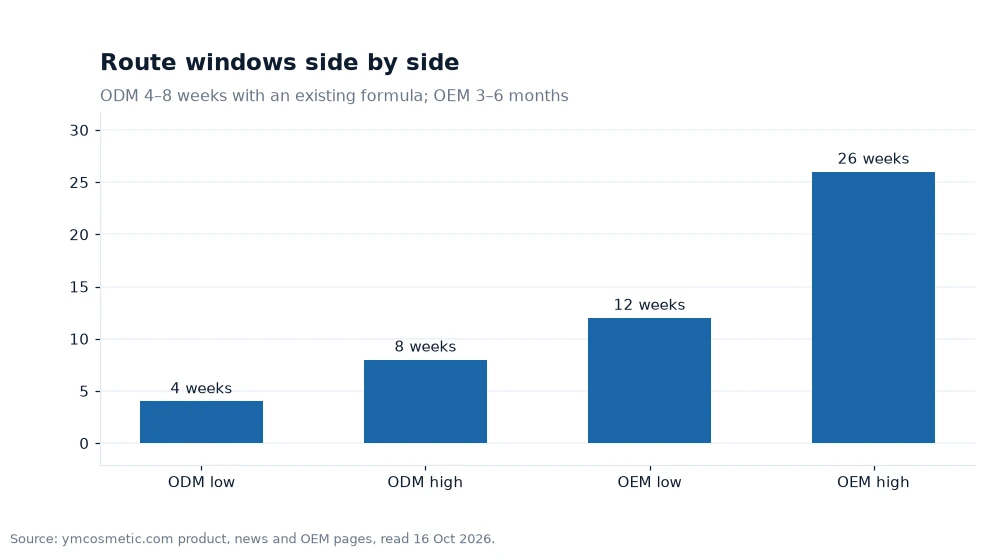
Two numbers frame the choice: the ODM high of 8 weeks and the OEM high of 26 weeks. The ratio between them is 26 ÷ 8 = 3.25, so the ODM route is roughly three times faster at the slow end. Read the chart as a speed-versus-ownership trade rather than a quality ranking, because both bars describe the same factory doing different work.
Choosing on ownership, not on price
Price is a symptom, not the cause. The route that owns more development work carries more cost and more time, and the route that owns less carries less of each. Comparing a bare ODM quote with an OEM quote that hides development is not a comparison at all. The two replies describe different amounts of work, and the difference is the ownership split you already chose.
Decide ownership first, then let the price land where it lands. If the brand values a formula it already holds, OEM protects it. If the brand values speed and is open to a library start, ODM fits better. Neither choice is permanent, and a supplier that runs both routes makes the later switch a conversation rather than a restart.
Frequently asked questions
What is the difference between OEM and ODM cosmetics manufacturing?
Under OEM the brand provides the formula, while under ODM the manufacturer develops it and offers end-to-end service from product design and formula development to production.
How long does each route take?
ODM runs 4–8 weeks with an existing formula, and OEM takes 3–6 months because it includes development, testing and production.
Does choosing ODM mean giving up control of the formula?
ODM means the manufacturer develops the formula; the brand still chooses the concept, the market and the claims, and more than 10,000 mature formulas are available to start from.
Pick by ownership, then set the budget
Write the ownership split first, then build the budget around it. Two samples on the bench, one from each route, will usually settle the debate faster than any spreadsheet. Yunmei's lip gloss range shows how an ODM selection can still carry a strong brand direction, and the skincare ingredient notes show where fine-tuning sits once a base formula is chosen.
The data above was read from the manufacturer's public website on 16 Oct 2026.[1]